Esports Guide / UPDATED 2026-10-23
Esports Tournament Formats Explained: League, Groups, Swiss and Finals
Tournament formats determine how teams qualify, how often they play, and how a champion is decided. A bracket image alone rarely tells the whole story: some events use group points, some use a Swiss stage, and others use elimination brackets before a final. This guide explains the vocabulary that helps viewers read esports results correctly.
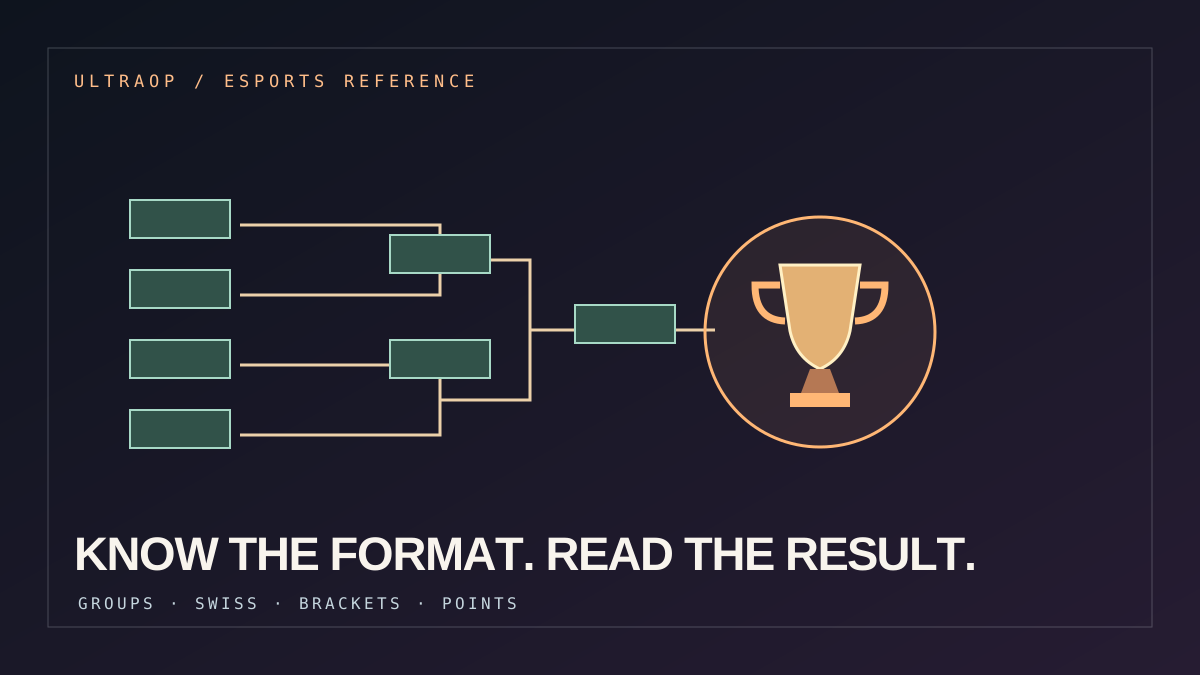
Original editorial illustration for this article; not an official in-game screenshot.
7 minute read · Last reviewed 2026-10-23
Key takeaways
- Round robin gives each participant a defined set of opponents; group stages often use round robin within each group.
- Swiss stages pair teams with similar records over a set number of rounds, with event-specific qualification rules.
- Single and double elimination brackets differ in how a loss affects a team’s path.
- Battle royale events often combine placement and elimination points across several matches.
- Always check the event’s official rulebook for tie-breaks, map pool, roster rules and qualification criteria.
Round robin and groups
In a round-robin stage, each participant plays the other participants in the group or league according to the event schedule. Points or match wins determine the table, followed by published tie-breakers where needed. It can give teams a more complete set of opponents, but the number of matches grows quickly as the field gets larger.
A group-stage event divides the field into smaller pools. Teams may play round robin within each group, with the top finishers qualifying for playoffs. The event rulebook decides how many advance, whether records carry forward and how ties are broken.
Swiss stage
A Swiss stage runs a set number of rounds without requiring every team to play every other team. Teams are usually paired against opponents with similar win-loss records, and published rules determine when a team qualifies or is eliminated. The exact number of rounds, seeding and tie-break calculations differ by event.
Do not infer that all Swiss stages use the same number of wins to qualify. Read the tournament’s format announcement and official bracket; one event may use different qualification thresholds from another.
Single and double elimination
In single elimination, a team exits the bracket after its first tournament loss. It is easy to follow and creates a direct path to the final, but one poor match can end a team’s run. Double elimination gives a team that loses in the upper bracket another route through a lower bracket; a second loss usually ends the run.
Some double-elimination formats also have a grand-final reset rule, while others do not. The phrase “double elimination” alone does not tell you all the details. Check how the lower-bracket winner must defeat the upper-bracket winner and whether a reset match is possible.
Points-based battle royale
Battle royale events commonly play several matches and assign points for placement and eliminations, with the weights defined in the season’s rulebook. The final leaderboard aggregates results across the designated matches; one match win does not automatically mean the team wins the whole tournament.
Rules can change between events, including match count, placement-point curve, tie-breakers, lobby composition and any match-point system. Compare teams using the scoring rules that were active in that specific year, rather than applying a current points table to a historical tournament.
How to verify a champion result
This is why UltraOP maintains individual history pages for PUBG PC PGC, PUBG Mobile PMGC, BGIS/BGMS, Free Fire World Series and VALORANT Champions. Each page labels its own series instead of combining trophies into one misleading list.
- Use the full event title and year.
- Confirm the exact game and mode.
- Find the organiser’s final result or official bracket.
- Record the grand-final placement and tie-break details when relevant.
- Keep regional league, Masters event, national series and world championship winners separate.
Sources and further reading
Game-specific details should be checked against the publisher or tournament organiser’s original notes. This article is an editorial summary.
Related guides
- Esports Tournament History: PUBG, BGMI, Free Fire and VALORANT
A structured esports reference for global PUBG championships, BGMI India series and Masters Series winners, Free Fire World Series champions and VALORANT Champions winners.
- PUBG Global Championship History: Winners from 2019 to 2025
A year-by-year PUBG: BATTLEGROUNDS PC global championship guide, including PGC winners Gen.G, NewHappy, NAVI, Danawa Esports, The Expendables and FULL SENSE.
- BGMI Tournament Winners: BGIS and BGMS Champions List
BGMI esports history with separate year-by-year BGIS and BGMI Masters Series champions, including Team SouL, Gladiators, Team XSpark, Versatile, K9 and Nebula Esports.
- VALORANT Champions Winners: World Champions from 2021 to 2026
Complete VALORANT Champions winner timeline from Acend in 2021, LOUD in 2022, Evil Geniuses in 2023, EDward Gaming in 2024, NRG in 2025 and LOUD in 2026.
- PUBG Mobile Global Championship Winners: PMGC History 2020–2025
PMGC champions by year from Nova Esports in 2020 and 2021 to S2G Esports, IHC, Dplus KIA and Alpha7 Esports, plus a clear note about the upcoming 2026 event.
Official website of UltraOP / Sk Ahsan Ahmad · Home · Guides · Games · Esports